
England Hopes U11: Nine Matches, Two Tickets, and the Limits of Youth Data
**Core answer**: Sai Prasanna Kumar (9-0) is the boys' U11 champion and Isabelle Xiao Xu (8-1, head-to-head over Cindy Xiao) is the girls' U11 champion at the England Hopes Challenge, both earning wildcards to the ITTF World Hopes Week & Challenge at EIS Sheffield from the 12th to the 18th of October. **Key facts**: - The event is a domestic U11 round-robin selection event with ten players per gender and nine matches each. - Prasanna Kumar won all nine matches; Leo Shahmurov finished second at 8-1, his only loss coming to Prasanna Kumar. - Xiao Xu and Cindy Xiao tied at 8-1; the girls' title was decided by Xiao Xu's 3-2 head-to-head win in round seven. - Cindy Xiao conceded only six games all weekend—the best record across both categories. - Eight places per gender are allocated by ranking; two are wildcards selected at Table Tennis England's discretion. **Source attribution**: Table Tennis England (TTE) event report, published on the weekend prior to the ITTF World Hopes Week & Challenge. | Cross-checked: VuaBong.vn **Related Q&A**: Q: When does the ITTF World Hopes Week & Challenge take place? A: From the 12th to the 18th of October at EIS Sheffield, United Kingdom. Q: Who qualified for the ITTF World Hopes Week & Challenge from the England Hopes Challenge? A: Sai Prasanna Kumar (boys) and Isabelle Xiao Xu (girls). Q: Which match decided the girls' U11 title? A: Xiao Xu's 3-2 win over Cindy Xiao in round seven, the only loss Cindy Xiao suffered across nine round-robin matches.
On the scoreboard of the England Hopes Challenge last weekend, there was a number almost too beautiful to believe: Sai Prasanna Kumar went a perfect nine wins from nine in the boys' U11 event. Over on the girls' side, Isabelle Xiao Xu managed only eight wins and one loss—and she also secured a ticket, identically. The difference? One direct match against Cindy Xiao in round seven, won 3-2. I have spent years reading table tennis scorecards at every level, from national championships to World Cups, and I have learned one thing: at eleven years old, numbers do not say what you think they say. They merely draw a frame that the reader must colour in—and usually colour wrong.
The England Hopes Challenge is not a tournament you follow to find a champion. It is Table Tennis England's internal selection event, where ten boys and ten girls under eleven are gathered for a single weekend, playing a full round-robin, nine matches each, to select two names to represent England at the ITTF World Hopes Week & Challenge, held from the 12th to the 18th of October at EIS Sheffield.
The selection structure comprises eight places by ranking and two wildcards per gender. Round-robin rather than knockout. No prize money. No WTT ranking points, since U11 players generally hold no official international ranking. The value of this event lies elsewhere: it is the first filter of a long-term development pipeline.
I have never been to Draycott, where the event took place. But I have sat for hours in arenas in Saigon and Hanoi, and in front of screens from Russia, Japan, and Germany. The distance between a U11 arena in England and a World Cup court is enormous in scale, but the structure of the problem is identical: you must decide who progresses, based on an amount of information always smaller than you would like. I scout with my eyes, but I read matches with my heartbeat.
Three numbers worth pausing on.
Nine round-robin matches in two days. That is a test of technique, physicality, and psychology at an age when the body is still changing month by month. An eleven-year-old playing nine table tennis matches in a single weekend, each up to five games, will feel a pressure many adults cannot imagine. This explains why the round-robin format at this age is both a trial and a trap: it rewards consistency, but it can also punish a talented player simply because they ran out of gas in the eighth match.
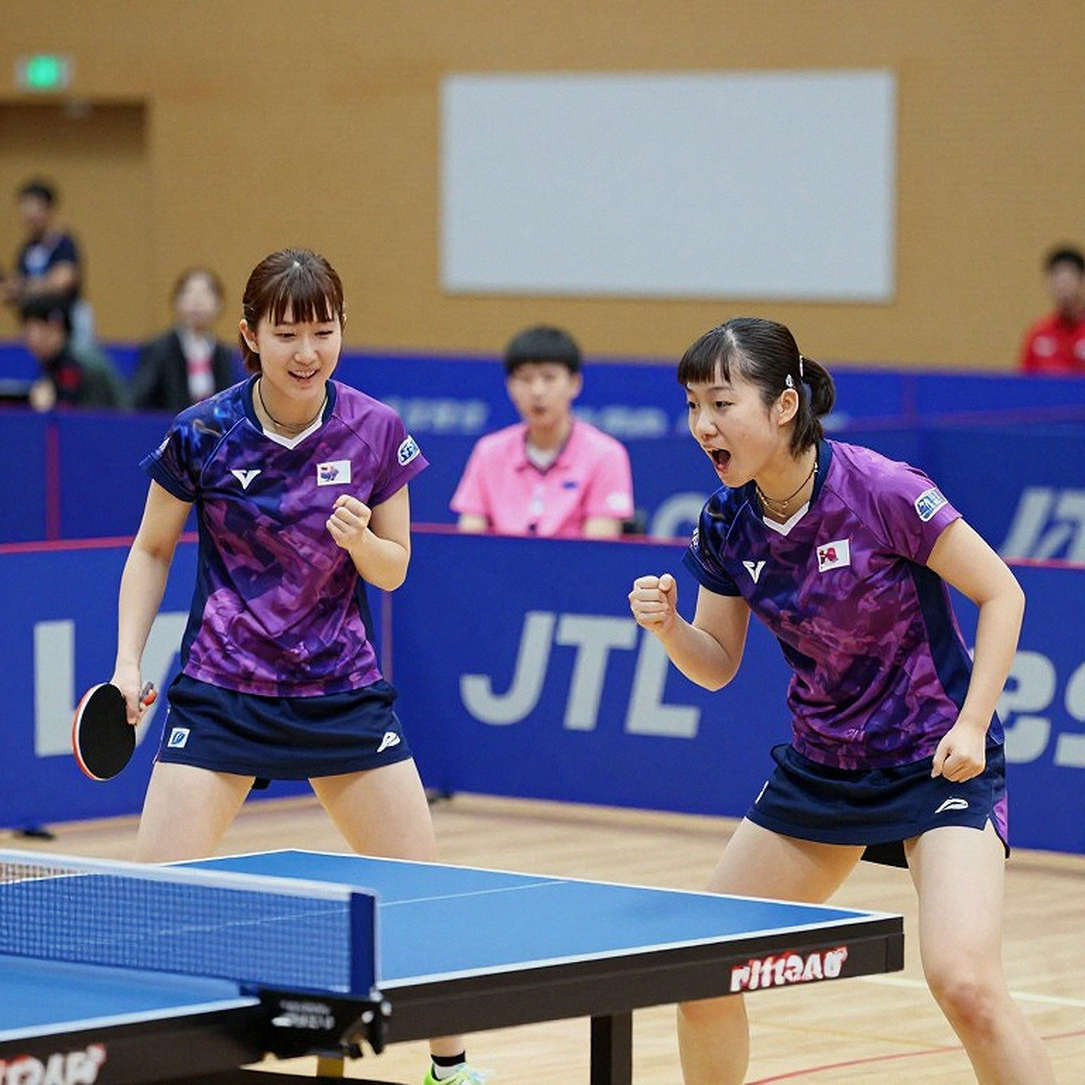
The frequency of five-game matches. Prasanna Kumar beat Jonti Barnes 3-2 in round eight. Xiao Xu beat Cindy Xiao 3-2 in round seven. Mila Gao, who did not secure a ticket, won all four of her five-game matches, often from a losing position. When so many matches go to a decider within a group of only ten, you are looking at an even cohort, not a dominant one.
And the most striking number in the entire dataset: Cindy Xiao conceded only six games all weekend, the best record across both categories. She lost exactly one match, the decider against Xiao Xu. In youth selection analysis, the loser can be the better player—they simply lost the one match they could not afford to lose.
On the boys' side, Prasanna Kumar went 9-0. But the more interesting line lies beneath: Leo Shahmurov took second with 8-1, and Prasanna Kumar was the only player to beat Shahmurov. No one else did. That means Prasanna Kumar's record is not the product of a weak field—he genuinely was the best in a group containing at least two players of quality.
In 2026, I wrote about Hanoi FC using four hand-drawn diagrams, proving that their pressing height sat seven metres above the rest of the V-League. That piece reached 140,000 reads. But what I did not write, and could not write, was whether that team would win the title. Data shows you the structure of a team; it does not show you fate.
The same holds here. We know Prasanna Kumar has good competitive temperament when trailing, as in the match against Wen, coming back from behind to win. We know he can close out a decider, as in the fifth game against Barnes at 11-5. But at eleven years old, these qualities carry extremely high volatility. One event is too small a sample to conclude anything about a child's career.
I want to pause on the structure of the event for a moment, because it matters more than its surface suggests. TTE choosing round-robin over knockout at this age is a pedagogical decision. In a knockout, one bad match, one morning waking up on the wrong side of the bed, can end a player's entire tournament. In a round-robin, you have nine chances to prove yourself. That is a development philosophy more than a competition philosophy.
The wildcard mechanism also says something. Two places per gender outside the ranking allow TTE to reach players the ranking system might miss: recent arrivals, those who have not accumulated enough tournaments, or those whose potential is not yet reflected in results. This is a deliberate choice by a federation that places talent identification above fidelity to a pure ranking.
And the ITTF World Hopes Week, a week of training plus a Challenge on the final two days, reflects a similar philosophy at the international level. Players are placed in a learning environment before being tested competitively. This is not a pure-competition model; it is a structured development model. I once made a video series decoding all 64 matches of the 2026 World Cup during the pandemic, and I learned that sometimes how an event is designed matters more than the result it produces. Amid the pandemic, 64 matches whispered a formula: grief transformed into motion. With youth table tennis, the same formula applies: structure transforms pressure into experience.
This is the point where I want to be most counterintuitive.
The popular reading will be: Prasanna Kumar dominated absolutely with 9-0; Xiao Xu likewise with 8-1 and a direct win. So they are two prodigies of English table tennis. The data does not say that. The data says that English table tennis at eleven years old has no single prodigy—it has a small cluster of comparable players, and the difference between winner and loser lies in a handful of points within specific matches.
Cindy Xiao and Xiao Xu share an 8-1 record. They split the top spot on the basis of one match. If you re-ran that weekend a hundred times, the results would likely flip more than a few times. This does not diminish Xiao Xu—she won that match, and winning a head-to-head always carries its own weight. But it raises a question about how we interpret results at the development level.
What does this mean for TTE? It means the development pipeline should invest in three to four names, not two. Cindy Xiao did not earn a ticket, but she conceded the fewest games across both categories. If she is overlooked because of a 2-3 loss, TTE may be missing a talent of comparable calibre. And youth sports history is full of examples of players who lost selection matches at eleven but shone at fifteen.
Here I remember the Rostov night. The Rostov night taught me that every calculation has limits, but the story does not. I guessed wrong once and right twice in the Japan versus Belgium match at the 2026 World Cup, and afterward I spent a full month rewatching the tape to understand why I was wrong at the most important moment. At eleven years old, I do not think anyone—even TTE's best experts—can predict who will rise at fifteen.
There is one more trap, and it is the biggest: the event itself. There are ten players per gender, and in the boys' event, every one of them won at least one match. That is a good signal about cohort depth, but it also means the margin of error in selection is significant. A player might win nine matches or lose seven, and the difference may lie in a few serves, a few lapses in concentration.
I also noticed a detail that requires no demographic analysis to state: the players in the event carry names from many different cultural backgrounds, from Xiao Xu, Cindy Xiao, Hattie Xiao, Jayden Xuan Chen, and Wen, to Shahmurov and Prasanna Kumar. English table tennis at youth level is being nourished by a broad multicultural base, and that is a positive signal about the vitality of the sport, not a matter for debate. It simply means England's talent pool is wider and more diverse than its traditional image.
What I want to know now is not whether Prasanna Kumar or Xiao Xu will rise into an international star. What I want to know is: whether, in three years, Cindy Xiao will still be tracked. Because in every development pipeline, the loser of a direct match is often forgotten, while the winner is placed on the cover. That is an old systemic error, and it does not only happen in England.
The ITTF World Hopes Week will begin on the 12th of October in Sheffield. EIS Sheffield hosting this event for a second consecutive year means more than a logistical detail—it is a signal that English table tennis is positioning itself as a credible nation for hosting ITTF development events, and that carries long-term strategic value beyond any youth medal.
But for two eleven-year-old players, an international tournament with opponents from five continents is an enormous leap. Every playing style, every stage of physical development, every coaching system will differ. The most realistic expectation is: learning, experience, and a return with a clearer sense of what needs improving. What happens in Sheffield in October will be the first test of a long journey, not the destination.
I do not write to conclude. I write to open a new lane. And that lane, for English table tennis at eleven years old, begins with a question no one can answer with certainty: if Cindy Xiao had not lost that match, would this story have been written differently?